


News
Beyond the Spin: How API Tracking is Changing Live Casino Strategies

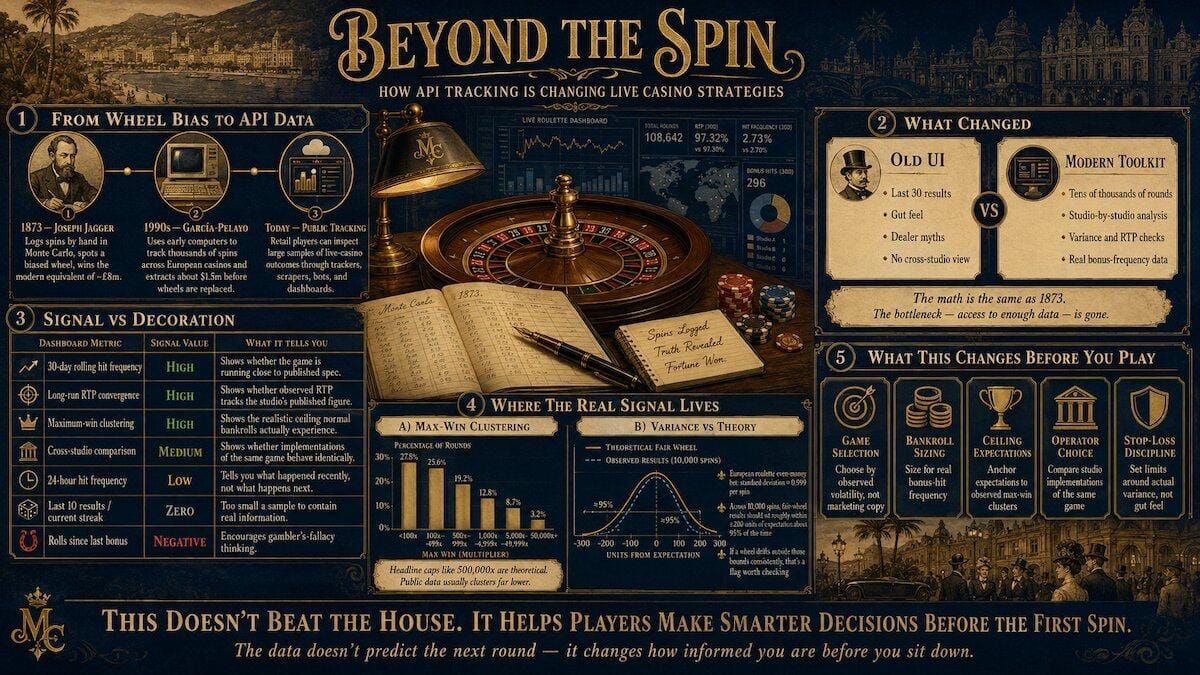
In 1873, a Yorkshire engineer named Joseph Jagger hired six clerks to log every spin at the Beaux-Arts Casino in Monte Carlo. After a week of hand-counted data, he identified that one of six wheels was returning nine specific numbers at a frequency the math didn't allow. He bet those numbers. He walked out with the modern equivalent of about £8 million.
A century later, Gonzalo García-Pelayo and his family did the same thing across multiple European casinos in the 1990s, using early personal computers to log spins. They extracted around $1.5 million before operators replaced their stock.
Both stories point at the same thing.
Data-driven roulette play has been a real edge whenever wheels were imperfect enough to produce detectable bias. The only thing standing between any retail player and the same approach was access to enough spin data for the math to mean something.
For most of online live casino's history, that data wasn't available. A bookmaker's UI showed you the last 30 results — meaningless on a 37-pocket wheel. Pure wallpaper.
And that wasn't even the worst of the problem. The same game runs across dozens of operator skins, each with its own studio setup, wheel rotation, and dealer roster. A player sitting down at "Live European Roulette" on one platform isn't necessarily sitting down at the same physical wheel — or the same statistical reality — as the player at the next operator over. Some studios run tighter to spec than others. Some dealers introduce more spin-pace variance than others. Some operator implementations of nominally identical games show subtle distribution differences worth knowing about.
For an analytical player, that's the first real question: not how to bet, but where to play. Which platforms are running cleanest? Which studios are tracking closest to theoretical? The bookmaker's UI cannot answer either question, because it was never designed to.
That's where the modern analytical toolkit starts. When analyzing live dealer roulette platforms, serious players no longer rely on the UI's basic spin history; they use third-party data aggregation to verify the true mathematical volatility of the wheel. Tens of thousands of recorded outcomes per game, broken down by studio and time window, sitting publicly on tracker pages anyone can read.
The math is the same as it was in 1873. The bottleneck — getting enough data to run it — is finally gone.
What the dashboard numbers actually mean
If you've spent any time on Tracksino, you've seen the numbers. The Monopoly Big Baller page right now shows roughly 691 rounds in the past 24 hours, 27 since the last 5 Roll bonus, biggest wins clustering at 186x, 133x, 70x in the past day, and a dice distribution where most outcomes sit in the 5–7% range per face value.
All of it is public. None of it is hidden. And we’re updating it in real time.
The question almost nobody asks is which of those numbers contains real signal and which is decoration. Most live casino reasoning falls apart not because players can't read the numbers, but because they read all of them with the same weight.
The honest hierarchy:
That last row is worth a beat.
Eighty rolls without a 5 Roll bonus is well within normal variance for a game where the bonus hits roughly once every 50–100 rounds. The streak is noise. The next round's probability is identical to round one's. The dashboard counter tells you what already happened — nothing more.
As a prediction tool, that single number does more damage than any other figure on the page.
Where the real signal lives
The genuinely useful dashboard reading is maximum-win clustering over time.
XXXtreme Lightning Roulette markets a 500,000x ceiling. Observable biggest-wins data, across months of public tracking, clusters at a small fraction of that. The same pattern shows up on Crazy Time, on Big Baller, on every game where the headline figure is a sub-1% theoretical outcome.
That gap — between the theoretical maximum and the realistic-session maximum — reframes the entire game. From "you might hit the headline" to "here's what this game can actually deliver to a normal bankroll." It's the single most useful piece of information on a live casino dashboard, and it's the one almost nobody looks at.
The standard deviation question, worked out
For roulette specifically, the math you can actually run from public data is variance against theoretical.
- Even-money bets on a single-zero wheel: standard deviation ≈ 0.999 per spin
- Built-in negative drift from the zero pocket
- Across 10,000 spins: cumulative outcomes should fall within roughly ±200 units of theoretical expectation about 95% of the time on a fair wheel
That's a testable claim. Public dashboards now publish enough spin data on enough live wheels to actually test it.
What you find, almost always, is that modern automated wheels track expectation within tight bounds. They're built specifically to do that — the physical bias Jagger exploited in 1873 has been engineered out of the modern industry. But the only way to know that's true on the specific wheel you're about to play is to run the math on real outcome data. The marketing doesn't tell you. The dashboard does.
What this changes in practice
None of this beats the house. The wheels are fair, the RNGs are validated, and dashboard reading doesn't convert a negative-expectation game into a positive-expectation one.
What it changes is the set of decisions you make before you sit down:
- Game selection based on observed volatility rather than marketing copy — two games with identical published RTP can produce wildly different practical variance
- Bankroll sizing against real bonus-hit frequency — a £500 bankroll survives a long dry stretch on one game and disappears in the same stretch on another
- Realistic ceiling expectations anchored to observed max-win clusters, not the studio's headline number
- Operator/studio choice when the same game runs across multiple implementations
- Stop-loss discipline calibrated to actual game variance instead of gut feel about whether the session has gone badly
Five decisions, all made before the first round is played. Each one moves the long-run outcome in the direction of the player's bankroll surviving.
That's not beating the house. It's playing a fundamentally different game than the player at the next table who still thinks red is due — and who, having watched eight reds in a row on the bookmaker's UI, is about to bet the rent on black.


May 18 - 3 min read
Double the Excitement: Discover the Big Welcome Offers at Grams.bet & Mega.bet
If online entertainment had a VIP lounge, Grams.bet and Mega.bet would definitely be on the guest list. Both brands are making waves with sleek platforms, massive game libraries, exciting sportsbook options, and generous welcome offers that instantly make new players feel like high rollers.

May 1 - 2 min read
Tracksino Levels Up: New Evolution Games Added for Real-Time Tracking
Big news for live casino fans - we're turning up the excitement with the launch of two brand-new titles from Evolution Gaming, all fully integrated into our powerful live data tracking system!!

Apr 7 - 4 min read
Patang Casino: A Fresh, Fun, and Rewarding Online Experience
Patang Casino is a vibrant online gaming platform that immediately stands out for its smooth design and welcoming feel.